
Unveiling poverty impacts by race and ethnicity
A new feature from PolicyEngine reveals how customizable tax and benefit reforms affect poverty rates for Black, White, Hispanic, and other Americans.

Contents
Current poverty rates: a racial and ethnic breakdown
Policy reforms through a racial and ethnic lens
Towards inclusive policymaking
As we observe Juneteenth, a day that marks the end of slavery in the United States, PolicyEngine sheds new light on the complex issue of poverty with new capacity to compute impact by race and ethnicity.
Current poverty rates: a racial and ethnic breakdown#
In our commitment to bring transparency to the impact of public policies, we’re excited to extend PolicyEngine to include racial and ethnic breakdowns, supplementing our existing age and sex analyses.
To provide a comprehensive perspective, we use the Supplemental Poverty Measure (SPM) in our evaluations. This measure goes beyond the traditional Official Poverty Measure (OPM) by accounting for variables such as taxes, in-kind benefits, local housing costs, among others.
Applying current law to the 2021 Current Population Survey March Supplement, we estimate that 8.8% of the population currently falls below their SPM poverty threshold. However, this figure diverges significantly when examined through the lens of race and ethnicity, revealing the following rates of poverty:
-
6.1% for White non-Hispanic individuals
-
10.9% for Other non-Hispanic individuals
-
12.2% for Hispanic individuals
-
15.0% for Black non-Hispanic individuals
Policy reforms through a racial and ethnic lens#
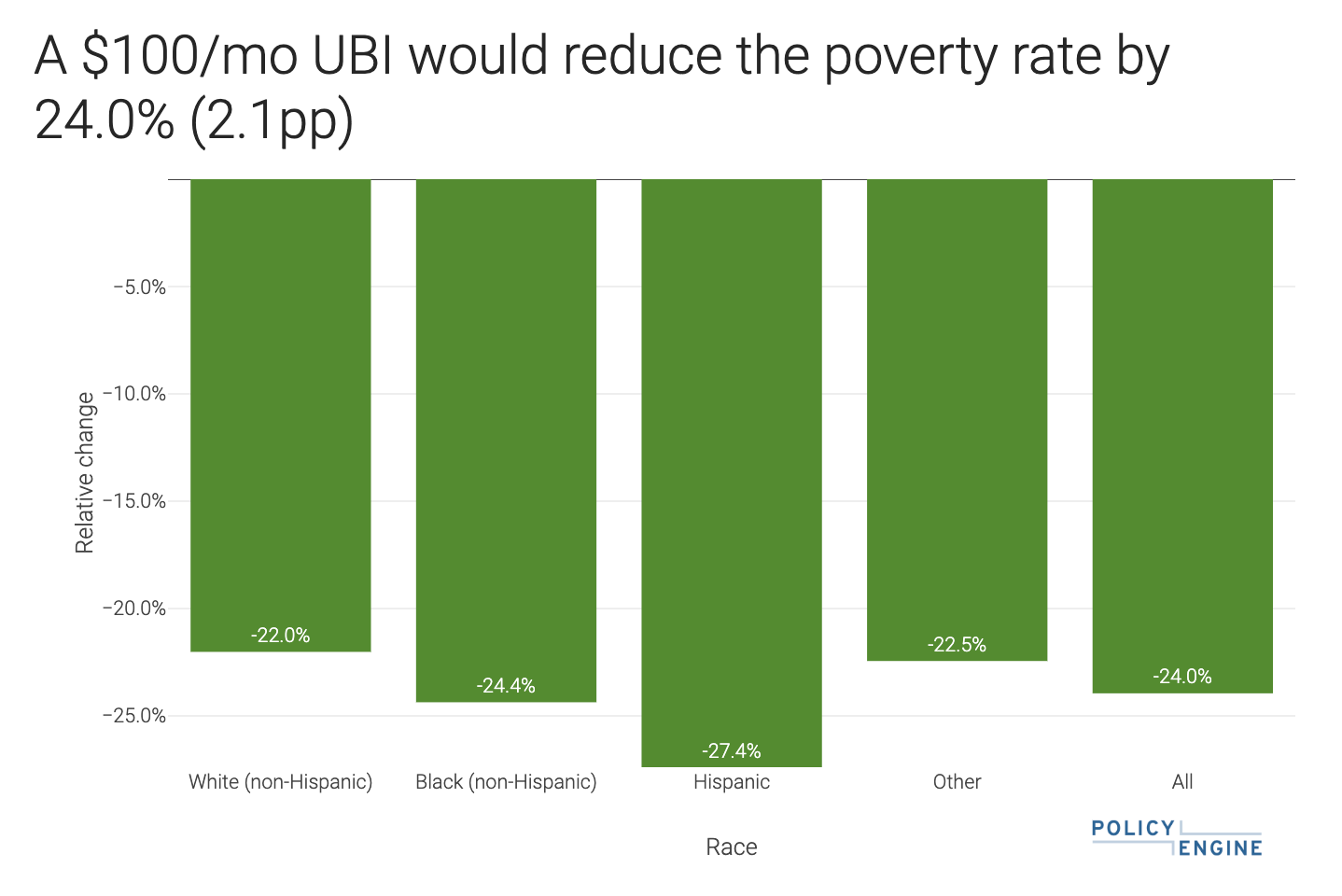
To illustrate these new capabilities, consider the example of a universal basic income of $100 per month. Our analysis reveals that this reform would lower the SPM poverty rate by 24%, with a more pronounced effect among Black and Hispanic Americans.
Towards inclusive policymaking#
This additional feature to our tax and benefit reform calculator enables policymakers, researchers, and advocates to better assess how public policies influence poverty rates across various racial and ethnic groups.
As we commemorate Juneteenth, we recognize the existing racial and ethnic disparities in poverty rates, and encourage those shaping public policy to consider how impacts on these disparities align to societal values.

PolicyEngine's Co-founder and CEO