
What's the SALTernative?
Introducing PolicyEngine’s free SALT‑AMT calculator — an open‑source web app to model next year’s SALT‑cap sunset, tweak AMT parameters, and see the budget, distributional, and household impacts in seconds.

Contents
Why a SALT + AMT model, and why now?
What you can do with SALTernative
Join us to learn more — April 24 webinar
Get started
Today we’re excited to launch SALTernative, a free web app that lets anyone — from researchers and journalists to households and Hill staff — simulate reforms to the state‑and‑local‑tax (SALT) deduction and the Alternative Minimum Tax (AMT) and see their effects on:
-
The federal budget (2026–35)
-
Average household incomes across the distribution
-
Individual households’ net income, effective SALT caps, and property‑tax subsidy rates
You can start exploring right now at policyengine.org/us/salternative.
Why a SALT + AMT model, and why now?#
-
Major policy change may be imminent. When individual provisions of the Tax Cuts and Jobs Act expire after 2025, the explicit $10,000 SALT cap vanishes and AMT parameters revert, reshaping incentives for millions of taxpayers.
-
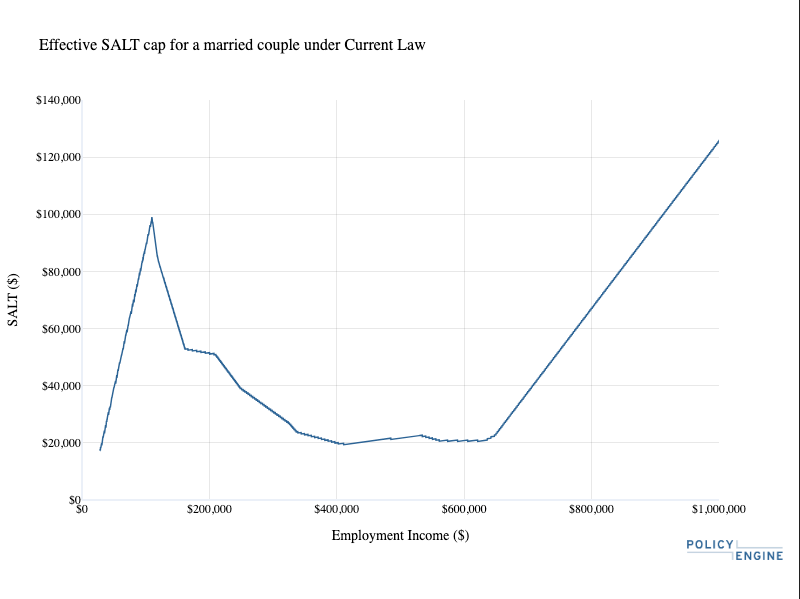
The interaction matters. The AMT disallows the SALT deduction, creating an effective SALT cap that can remain even without a statutory cap.
-
Transparent evidence is scarce. While existing estimates are static tables for individual reforms, SALTernative is flexible, open‑source, and free.
What you can do with SALTernative#
Key features at launch include:
-
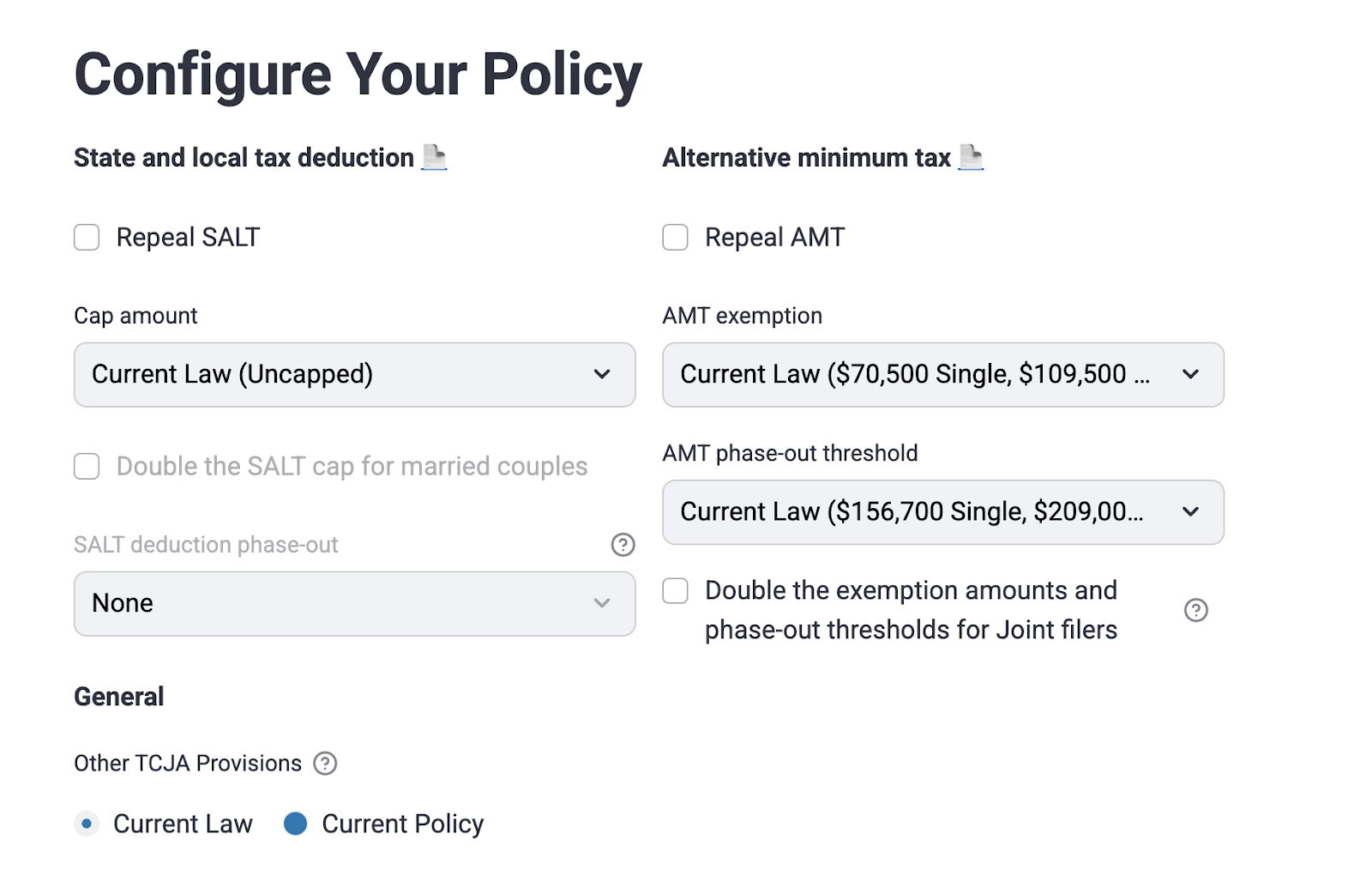
Current‑law vs. current‑policy baselines. Simulate against either an automatic TCJA sunset or a full extension.
-
Behavioral responses. Optionally incorporate CBO elasticities so earnings adjust when marginal tax rates change.
-
Transparent methodology. We’ve developed the tool open-source on GitHub, using the open-source PolicyEngine US microsimulation model — including a full set of state income tax rules, critical for SALT and AMT calculations.
Join us to learn more — April 24 webinar#
We’re hosting a joint webinar with Arnold Ventures (whose generous support made SALTernative possible) on Thursday, April 24, at 10 AM ET.
We’ll walk through live demos, answer technical questions, and discuss how analysts are already using the model.
Get started#
-
Head to policyengine.org/us/salternative.
-
Choose a baseline, adjust SALT and AMT settings, and watch the charts update.
-
Share your findings, cite the model, and help create a world guided by transparent, verifiable evidence.
Thank you to Arnold Ventures for supporting this work, and to our open‑source contributors who reviewed code, built datasets, and stress‑tested the interface.
See you at the webinar!

Economist at PolicyEngine

PolicyEngine's Co-founder and CEO