
Extending the Winter Fuel Allowance
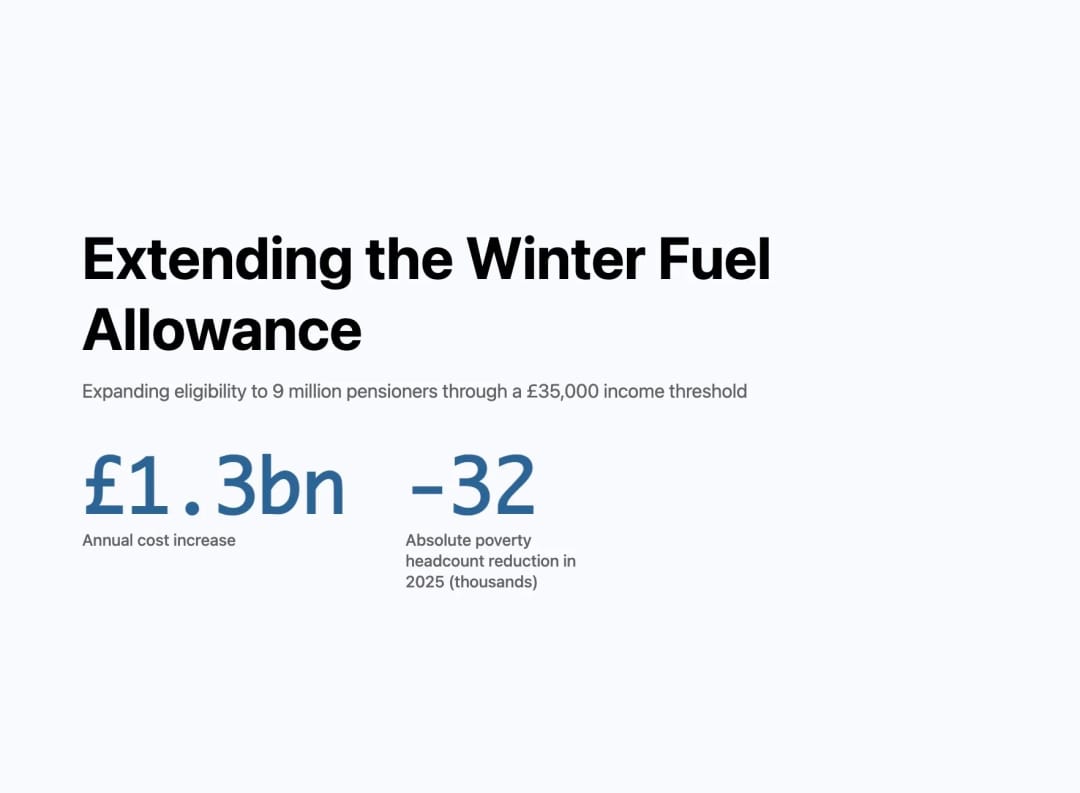
The government has reversed its Winter Fuel Allowance means testing, expanding eligibility to 9 million pensioners through a £35,000 income threshold.
Contents
Original policy
New policy
Household impacts
Economic impacts
Poverty rates
Inequality
The Labour government has announced changes to its Winter Fuel Allowance policy, expanding eligibility from 1.5 million to 9 million pensioners in England and Wales. The new £35,000 income threshold replaces the previous restriction to Pension Credit recipients only.
Original policy#
The Winter Fuel Payment provides £200 for households with someone of State Pension age and £300 for households with someone aged 80 or over.
In July 2024, the government restricted Winter Fuel Payments to pensioners receiving Pension Credit or other means-tested benefits. The Department of Work and Pensions reports that this reduced the number of recipients from 11.4 million to 1.5 million pensioners - a reduction of 9.9 million people.
New policy#
From winter 2025/26, all people above State Pension age in England and Wales with taxable income of £35,000 or less will receive Winter Fuel Payments; the amounts do not change. Those with income above £35,000 will receive the payment, but have it recovered through HMRC via PAYE or Self-Assessment.
The £35,000 threshold applies to individual income, not household income. If any person is eligible under this taxable income means test, the DWP will pay the benefit amount to the household.
Household impacts#
For a single 70-year old, the new policy increases their net income by £200 between around £11,000 (where Pension Credit entitlement ends) and £35,000 in taxable income.
Economic impacts#
We estimate this reform will increase the deficit by £1.33 billion per year (the government estimates £1.26 billion in 2025/26), totaling £6.6 billion over the next five years.
We estimate that the reform will also benefit the second income decile the most in 2025, with the top three deciles benefitting by less than 0.1%.
Poverty rates#
The government reports annually on four poverty metrics:
- Absolute poverty before housing costs: households with income below 60% of the 2010/11 median income, adjusted for inflation.
- Absolute poverty after housing costs: households with income below 60% of the 2010/11 median income after housing costs, adjusted for inflation.
- Relative poverty before housing costs: households with income below 60% of the median income in the current year.
- Relative poverty after housing costs: households with income below 60% of the median incomeafter housing costs in the current year .
For each of these metrics, we simulate the change in the poverty rate and headcount as a result of the policy change. All reported years are fiscal years.
Table 2: Absolute poverty before housing costs
Table 3: Absolute poverty after housing costs
Table 4: Relative poverty before housing costs
Table 5: Relative poverty after housing costs
Inequality#
We also project income inequality metrics in PolicyEngine's open source model, including the Gini coefficient, the share of income held by the top 10 percent, and the share of income held by the top 1 percent.
Table 6: Gini coefficient
Table 7: Top 10% share
Table 8: Top 1% share
View the full PolicyEngine analysis here and use our household calculator to see how these changes affect individual households.

Former PolicyEngine co-founder