
Capital Gains Tax reforms in the Autumn Budget 2024
PolicyEngine estimates that the UK's 2024 Capital Gains Tax reforms will raise £6.4 billion between 2025-2029.

Contents
Budgetary impacts
Distributional impact
The Autumn Budget 2024 includes substantial reforms to Capital Gains Tax (CGT), with Chancellor Rachel Reeves announcing rate increases across all tax bands. The changes raise the rates from 10% and 20% to 18% and 24%, respectively.
When accounting for behavioural responses, we project that these changes will raise £6.4 billion from 2025 to 2029. In 2025 without behavioural responses, they will affect 1.2% of the population and reduce the Gini index of income inequality by 0.4%.
Budgetary impacts#
We project the CGT reforms will raise £6.4 billion from 2025 to 2029.
These estimates are 29% less than HMT and 26% less than the OBR. These variations may stem from different assumptions about behavioural responses. In our model, we assume individuals will adjust their capital gains realisations with an elasticity of -0.7 with respect to the marginal tax rate; neither HMT nor OBR specify their assumptions on this front.
Assuming no behavioural change, we project the change to generate £22.2 billion from 2025 to 2029. While the OBR also provides estimates it describes as static, those account for changes in realisation behaviour, making them incomparable to our static results.
Distributional impact#
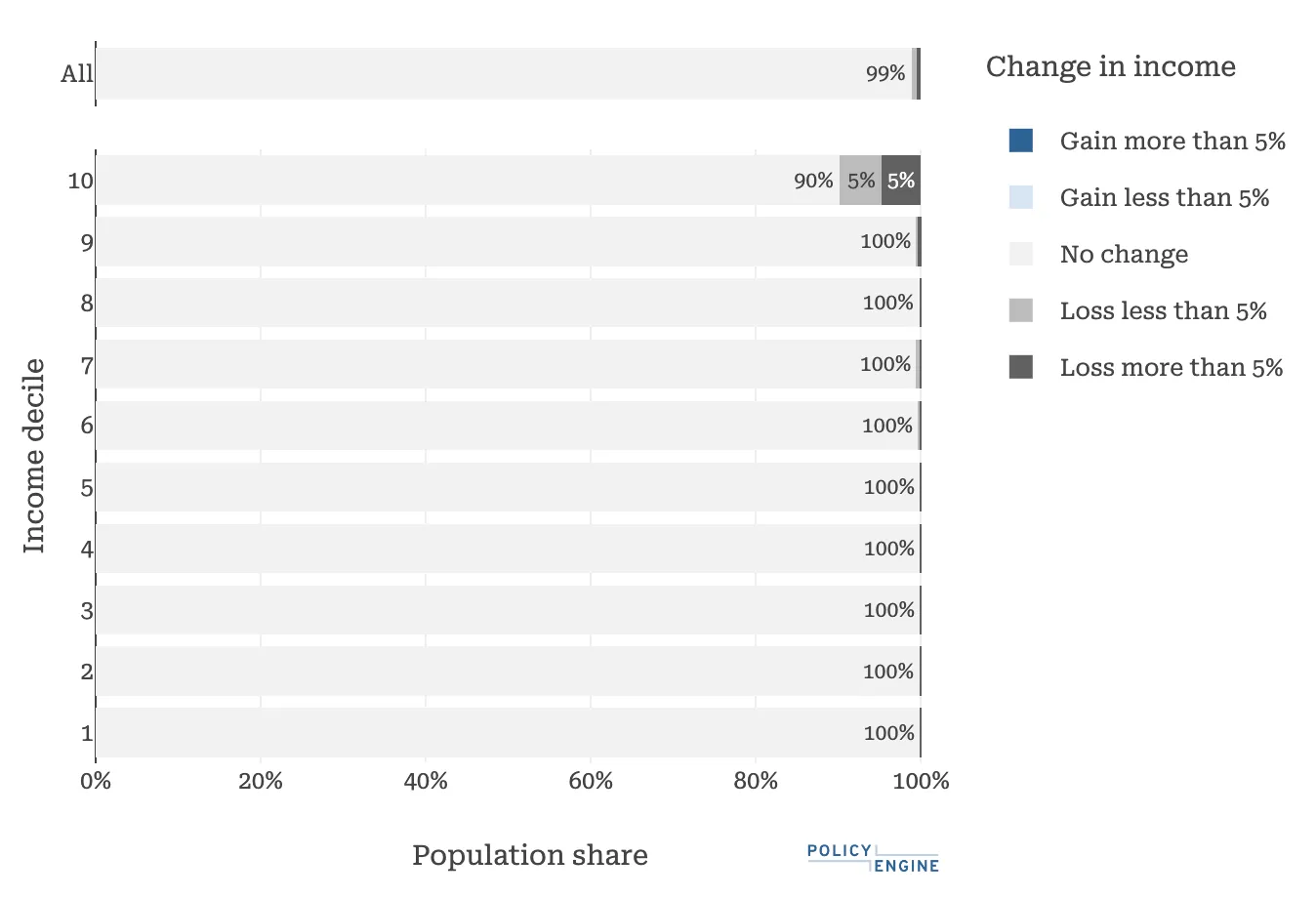
The CGT reforms affect 1.2% of the population, with impacts limited to the highest income decile. Within the top 10%, 5% see income losses above 5%, another 5% face losses under 5%, while 90% experience no change. The policy has no impact on income levels across the bottom nine deciles.
Our distributional analysis shows no change in poverty measures, while the Gini index falls by 0.4%. Across most of the income distribution (the bottom 90% of households), incomes remain unchanged.
Read more of PolicyEngine’s Autumn Budget 2024 coverage:

Research Associate at PolicyEngine